A leaking pump rarely stays a small maintenance issue. It can waste product, create a slip hazard, expose personnel to process fluids, damage bearings, and interrupt production. When evaluating mechanical seals versus packing, the right answer depends on the pump, fluid, operating conditions, maintenance resources, and the true cost of leakage over time.
Both sealing methods are proven in industrial service. Packing has been used for generations because it is straightforward, adaptable, and serviceable in the field. Mechanical seals offer tighter fluid containment and can reduce routine adjustment needs in many applications. Neither option is automatically better in every pump. The practical goal is to select the sealing arrangement that protects equipment, supports safe operation, and keeps downtime under control.
Mechanical Seals Versus Packing: The Core Difference
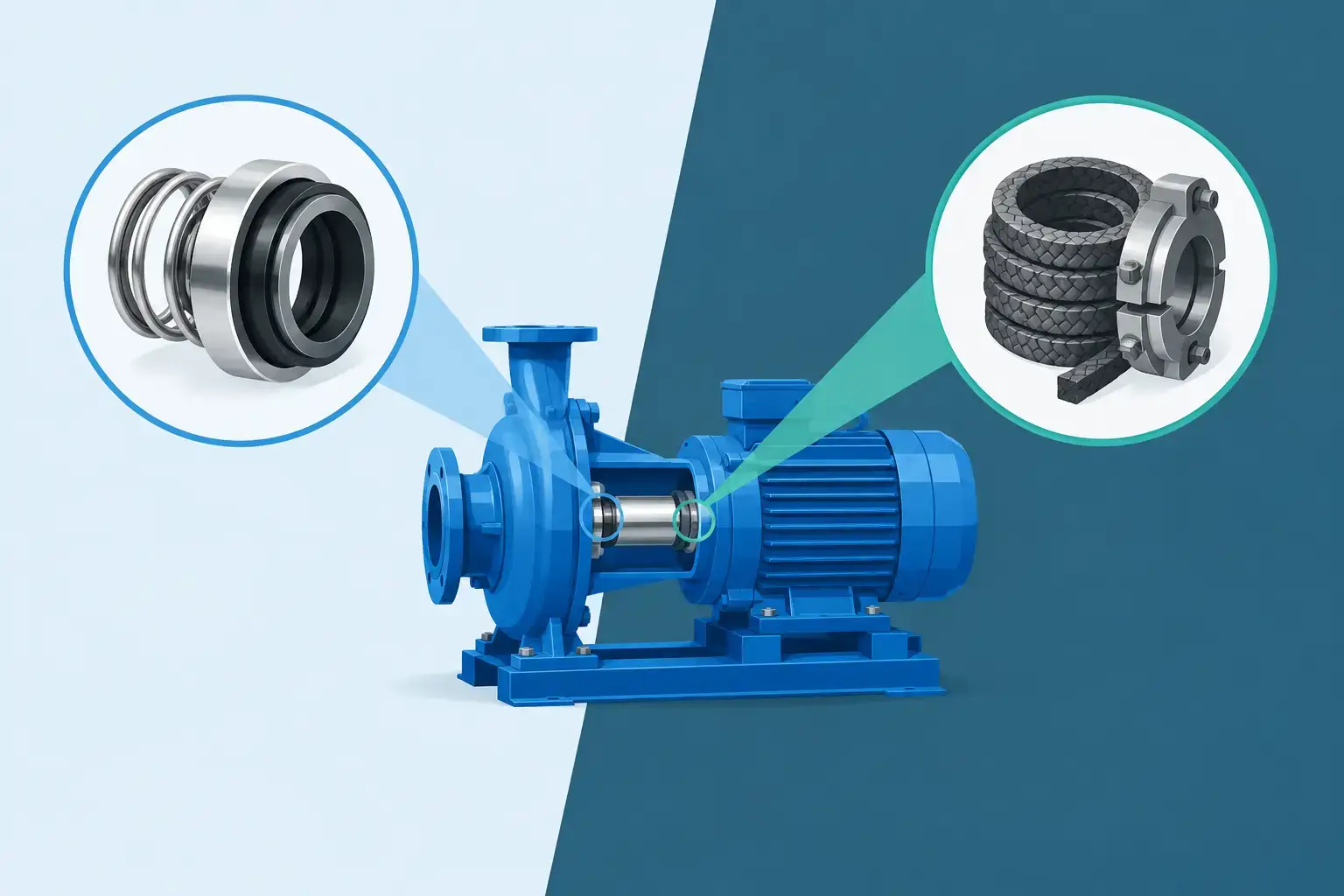
Packing seals a rotating pump shaft with compressible rings installed around the shaft or sleeve inside a stuffing box. A gland follower compresses the packing to create resistance against fluid escape. Packing is designed to allow a controlled amount of leakage in many applications. That leakage lubricates and cools the packing at the shaft interface.
A mechanical seal uses precisely matched sealing faces, typically one rotating with the shaft and one stationary in the seal chamber. Springs and hydraulic pressure hold these faces together while a very thin fluid film supports their operation. Secondary sealing elements, such as O-rings or gaskets, prevent leakage around the seal components.
The difference matters operationally. Packing controls leakage through compression and requires periodic adjustment. A properly selected mechanical seal is intended to provide much lower visible leakage, but it requires correct installation, appropriate operating conditions, and suitable materials for the fluid and temperature.
When Packing Is the Practical Choice
Packing remains a dependable option for many industrial pumps, especially where simplicity and field serviceability are priorities. Maintenance teams can often repack a stuffing box with standard tools and make adjustments while monitoring leakage rates. For facilities with experienced maintenance personnel, that familiarity can be valuable.
Packing may be a sensible choice for water handling, irrigation, wastewater, slurry service, and other applications where a small, managed amount of leakage is acceptable. It can also perform well where shafts have minor wear, alignment is not ideal, or process conditions change frequently. In some abrasive services, specialized packing can be a practical and economical solution.
The trade-off is that packing needs attention. If it is tightened too much, friction and heat can accelerate shaft sleeve wear, increase power consumption, and shorten packing life. If it is too loose, leakage can become excessive. Operators must monitor the stuffing box, make periodic adjustments, and plan for replacement before performance declines.
Packing also places more direct contact load on the shaft or sleeve than a mechanical seal. Over time, this can lead to wear that requires sleeve replacement or shaft repair. That cost should be considered alongside the relatively low upfront cost of packing materials.
Where Mechanical Seals Deliver Greater Value
Mechanical seals are often selected when leakage control, equipment protection, and reduced routine maintenance are central requirements. They are common in chemical processing, oil and gas operations, power generation, food and drug production, and applications involving expensive, hazardous, hot, or environmentally sensitive fluids.
A correctly specified mechanical seal can substantially reduce product loss and housekeeping demands compared with conventional packing. This is particularly valuable where leaked fluid presents safety concerns, contamination risk, regulatory exposure, or cleanup costs. In a food or pharmaceutical process, for example, better fluid containment supports cleaner operations and helps protect product integrity.
Mechanical seals can also reduce shaft or sleeve wear because their primary faces are not compressed directly against the rotating shaft in the same way as packing. With the right seal design, installation, and support conditions, this can extend the service life of rotating equipment components.
However, mechanical seals are not maintenance-free components. Dry running, cavitation, vibration, misalignment, excessive heat, solids buildup, or incompatible materials can cause early seal failure. A seal that is correct for clean water may not be suitable for a hot hydrocarbon, abrasive slurry, corrosive chemical, or crystallizing fluid. The mechanical seal must be matched to the actual duty, not simply the pump model.
Leakage Expectations and Process Risk
The acceptable leakage level is often the first decision point. Packing normally requires controlled leakage for cooling and lubrication. That may be acceptable for nonhazardous water, but it can be unacceptable when fluid is toxic, flammable, costly, sterile, or damaging to surrounding equipment.
Mechanical seals are generally the stronger choice where visible leakage must be minimized. Still, a single mechanical seal is not the only configuration available. Higher-risk duties may require a dual seal, barrier fluid system, or additional containment arrangement. The correct approach depends on process risk and site requirements.
Maintenance Labor and Downtime
Packing usually costs less to purchase and is easy to keep in storeroom inventory. The labor requirement can be higher over the life of the pump because packing must be adjusted, inspected, and periodically replaced. A maintenance team may accept that workload where pumps are accessible and leakage is manageable.
Mechanical seals often have a higher initial cost, particularly for engineered designs or difficult services. Yet the installed cost may be justified if reduced leakage, fewer adjustments, lower cleanup needs, and improved equipment protection prevent unplanned downtime. The lowest purchase price is not always the lowest operating cost.
Operating Conditions and Fluid Properties
Process conditions should drive the selection. Temperature, pressure, shaft speed, solids content, viscosity, corrosiveness, vapor pressure, and available flush or cooling all influence seal performance. So do pump condition and operating behavior. Frequent starts and stops, suction problems, vibration, and operation away from the pump’s best efficiency point can change what a seal must withstand.
Packing can tolerate certain imperfect operating conditions better than a precision mechanical seal, provided maintenance personnel manage it correctly. Mechanical seals are often preferred for demanding containment requirements, but they need a stable environment and appropriate support plan. For example, abrasive solids may call for flushing, a specialized seal face combination, or a different pump arrangement rather than a standard mechanical seal.
How to Make the Right Pump Seal Decision
A reliable selection process starts with the application, not the catalog. Identify the fluid, its concentration, temperature range, pressure, solids content, and any hazard or cleanliness requirements. Then review pump size, shaft dimensions, seal chamber configuration, operating speed, and the condition of the shaft or sleeve.
Next, consider how the facility will maintain the equipment. If operators can safely monitor and adjust packing and a small leak is acceptable, packing may offer a cost-effective answer. If the process cannot tolerate routine leakage or repeated intervention, a mechanical seal may provide better long-term protection.
It is also wise to calculate the cost of failure in practical terms. Include lost product, cleanup, labor, emergency repairs, safety exposure, environmental concerns, and production interruption. A seal selection that appears inexpensive at installation can become costly when it causes repeated pump outages.
Avoiding Common Selection Mistakes
The most common error is treating all pump leaks as a packing or seal problem alone. A new component cannot correct shaft runout, worn bearings, pipe strain, cavitation, improper alignment, or an unsuitable operating point. These conditions should be addressed before replacement parts are installed.
Another mistake is specifying by dimensions only. Dimensions are essential, but material compatibility and operating conditions are equally important. Seal faces, elastomers, springs, and metal components must withstand the service fluid and temperature. For packing, fiber type, lubricant, construction, and ring size need to match the duty.
Finally, do not overlook installation practices. Mechanical seal faces must be protected from damage and kept clean during assembly. Packing rings should be cut and installed correctly, with joints staggered and compression applied gradually. Careful installation is one of the most effective ways to improve service life for either option.
Get Support for the Actual Operating Duty
The choice between mechanical seals and packing should support the full reliability plan for the pump. Buyers should expect more than a part number – they need confidence that the replacement fits the equipment and the conditions it will face. Providing pump details, fluid information, operating parameters, and failure history allows a seal specialist to recommend a more suitable solution.
International Seals helps industrial buyers source mechanical seals, packing-related sealing components, O-rings, rotary shaft seals, and gasket systems for demanding maintenance and replacement needs. Direct technical guidance can help teams move from a recurring leak issue toward a selection that better protects equipment and production.
The most useful question is not which option is universally best. It is which sealing method gives your specific pump the strongest balance of containment, maintainability, safety, and operating cost – then supports that decision with correct installation and disciplined pump maintenance.
Leave a Reply