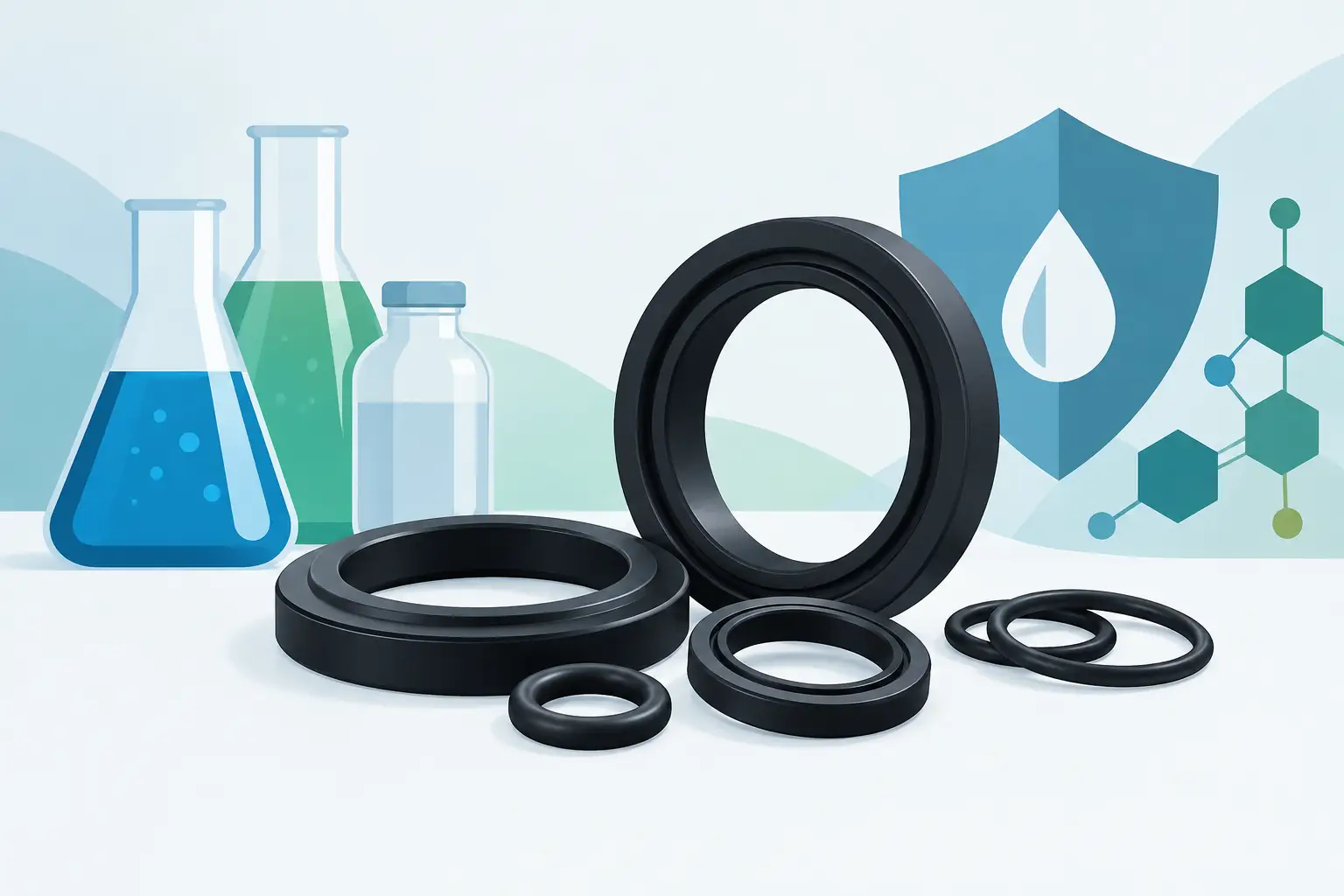
A seal can appear intact during routine inspection and still be close to failure. Chemical attack often begins with swelling, hardening, softening, cracking, or a gradual loss of elasticity that changes how the seal contacts its mating surfaces. For maintenance teams and equipment owners, selecting chemical resistant elastomer seals is not simply a material decision. It is a direct decision about leakage prevention, pressure retention, worker safety, product quality, and unplanned downtime.
The right seal must withstand the process fluid while continuing to perform under the actual conditions of service. Temperature, pressure, cycling, shaft movement, installation practices, and periods of inactivity all influence whether an O-ring, bonded seal, gasket, or rotary shaft seal will provide dependable protection.
What Chemical Resistance Really Means in a Seal
Chemical resistance is the ability of an elastomer to retain its useful physical properties after exposure to a fluid, gas, vapor, or cleaning agent. A material may resist one chemical very well and perform poorly in another. It may also work at room temperature but lose service life quickly when temperatures rise.
The concern is not limited to visible deterioration. Some chemicals cause an elastomer to swell. Swelling can initially increase contact pressure, but it can also reduce extrusion resistance, create friction, distort the seal, and make removal difficult during maintenance. Other media extract ingredients from the compound, leaving the seal hard, brittle, and unable to recover after compression.
A compatible material must do more than survive contact. It must maintain the compression set resistance, flexibility, dimensional stability, and sealing force needed for the equipment’s operating cycle. That is why a material listed as generally compatible is a starting point, not a final specification.
Chemical Resistant Elastomer Seals Start With the Media
The most useful question is not, “What is the toughest elastomer?” It is, “What exactly will this seal encounter?” Maintenance records often identify a primary fluid, but the seal may also contact washdown chemicals, flushing fluids, lubricants, condensate, additives, solvents, or occasional upset-process materials.
For example, a seal in a water treatment valve may see treated water most of the time, then be exposed to chlorine-based disinfectants or cleaning agents during maintenance. A seal in a food processing pump may contact edible oils, product residue, high-temperature wash cycles, and sanitizing chemicals. In oil and gas equipment, hydrocarbon exposure may be combined with pressure changes, sour-gas conditions, and elevated temperatures.
Accurate fluid identification matters. Generic names can hide important differences in concentration, blend composition, and temperature. “Solvent,” “oil,” or “caustic cleaner” does not provide enough information for a confident selection. When possible, provide the chemical name, concentration, service temperature range, and any available safety data to the seal specialist.
Common Elastomer Choices and Their Trade-Offs
Different elastomer families solve different exposure problems. The best choice depends on the full application, including the seal design and operating environment.
Nitrile, commonly called NBR or Buna-N, is widely used for petroleum-based oils, fuels, and many hydraulic fluids. It offers practical performance and value in general industrial service. Its limitations become more apparent with ozone, weather exposure, certain solvents, and high-temperature operation.
Fluoroelastomer, often identified as FKM, is frequently selected where high temperatures, petroleum fluids, fuels, and many aggressive chemicals are involved. It is a strong option for demanding process equipment, engines, pumps, and industrial transportation systems. However, FKM is not a universal answer. Some amines, ketones, steam conditions, and specialized chemicals can require a different compound.
EPDM performs well in many water, steam, glycol, and weather-exposed applications. It is common in water-management, irrigation, and certain sanitary systems. It is generally not the right material for petroleum oils and fuels, a mismatch that can lead to rapid deterioration.
Silicone is valued for flexibility across a broad temperature range and can be appropriate for select food, medical, and high-temperature static sealing applications. Its mechanical strength and tear resistance may not suit every dynamic industrial service. PTFE-based components and specialty perfluoroelastomers may be considered for highly aggressive media, but their cost, seal geometry, and equipment conditions need careful review.
Material names alone do not guarantee performance. Formulations vary between compounds, and a seal’s hardness, curing system, fillers, and approvals may affect how it behaves. A less expensive general-purpose compound can be the right choice for routine service. In a critical process line, paying for a compound matched to the chemical and operating profile may prevent a far more costly shutdown.
Temperature, Pressure, and Motion Change the Selection
Chemical compatibility charts are useful reference tools, but they do not fully replicate operating conditions. Temperature is one of the most significant variables because heat can accelerate chemical reactions and change elastomer properties. A seal that performs acceptably in a cool storage tank may fail early in a heated pump or steam-cleaned assembly.
Pressure adds another concern. As pressure rises, soft or swollen elastomers can extrude into clearance gaps. Back-up rings, tighter extrusion gaps, or a different seal design may be necessary to maintain pressure without damaging the sealing element. In dynamic equipment, shaft speed, lubrication, surface finish, runout, and friction also determine whether the seal can maintain a stable contact area.
Static seals are usually more forgiving than rotary or reciprocating seals, but they still depend on proper gland dimensions and controlled compression. Mechanical seals and rotary shaft seals require particular attention because chemical resistance must be matched with face materials, springs, secondary sealing elements, and the actual movement of the equipment.
Selecting the Right Seal Type
The seal category should support the application as much as the material does. O-rings are versatile for static and selected dynamic sealing points, but groove dimensions and squeeze must be correct. Bonded seals are commonly used around bolts, plugs, and threaded connections where reliable fluid containment is required. Gasket systems can protect larger flange interfaces where surface condition and bolt loading affect leakage risk.
Rotary shaft seals protect bearings, gearboxes, pumps, and rotating machinery from fluid loss and contamination ingress. Their performance depends on the elastomer lip material as well as shaft finish, lubrication, pressure capability, and installation alignment. Mechanical seals are often required when pumps handle hazardous, corrosive, or high-value fluids and leakage control is especially critical.
If the equipment has repeatedly failed with the same seal type, replacing it with the same part number may not resolve the underlying issue. The root cause may be chemical incompatibility, but it could also be gland damage, pressure spikes, dry running, heat buildup, poor installation, or an incorrect mating surface. A better replacement decision starts with the failure pattern.
Questions That Prevent Costly Mismatches
Before ordering replacement seals, gather the operating details that influence chemical resistance and service life. A complete application review should account for:
- Process media, concentration, contaminants, and cleaning chemicals
- Minimum, normal, and maximum operating temperatures
- Pressure range, pressure spikes, and vacuum exposure
- Static, rotary, or reciprocating motion and equipment speed
- Seal dimensions, gland geometry, and existing part identification
- Required certifications, cleanliness standards, or industry approvals
These details help narrow the material and seal configuration to options that fit the job. They also help identify when a standard replacement is sufficient and when an application-specific solution is the safer choice.
Installation and Storage Still Matter
Even correctly specified chemical resistant elastomer seals can fail prematurely if they are damaged during installation. Cuts, twists, rolled O-rings, sharp groove edges, and incompatible assembly lubricants can create an immediate leak path. Clean components, controlled installation tools, and verification of seal orientation are practical steps that protect the investment in the right material.
Storage deserves attention as well. Excessive heat, direct sunlight, ozone-producing equipment, and poor inventory rotation can age elastomers before they ever enter service. Keeping seals protected and traceable supports consistent maintenance results, especially when facilities stock replacements for critical assets.
For organizations managing varied equipment and fluid services, working with a supplier that can review the application saves time when conditions are unclear. International Seals helps industrial buyers align O-rings, bonded seals, rotary shaft seals, mechanical seals, and gasket solutions with the performance demands of their equipment.
When a process changes, treat the seal as part of that change. A new chemical, hotter wash cycle, different lubricant, or higher pressure setting may call for a new material or seal design. Reviewing those details before the next maintenance interval is one of the most practical ways to protect equipment, maintain pressure, and keep operations moving.
Leave a Reply