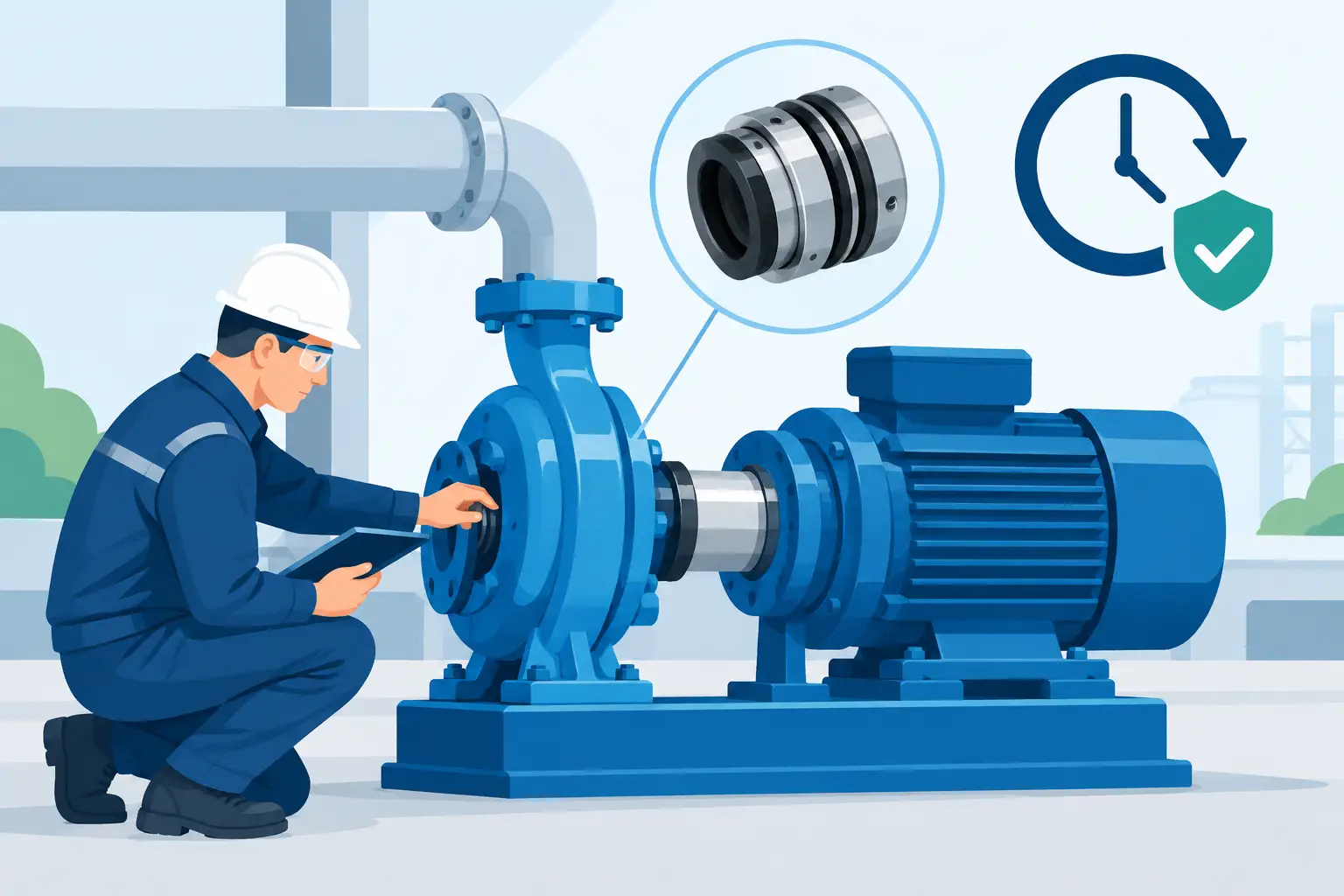
A leaking pump seal rarely fails without warning. A rise in visible leakage, heat near the seal chamber, vibration, or a pump that needs repeated adjustment can all signal a condition that will soon interrupt production. To reduce pump seal downtime, maintenance teams need to treat the seal as part of the complete pumping system, not as an isolated replacement part.
The right seal matters, but so do shaft condition, operating pressure, fluid characteristics, alignment, installation practices, and parts availability. Addressing those factors before failure turns seal maintenance from a recurring emergency into a planned reliability activity.
How to Reduce Pump Seal Downtime at the Source
Pump seal failures are often blamed on the seal itself, even when the cause began elsewhere. A mechanical seal may leak because the faces ran dry, a shaft seal may wear rapidly because of shaft runout, or an O-ring may swell because its material is not compatible with the process fluid. Replacing the same component without correcting the operating condition typically shortens the time until the next outage.
Start with a clear failure record. Document the pump model, seal arrangement, process fluid, operating temperature and pressure, run hours, leak location, and visible condition of removed parts. Over time, this information helps identify whether failures are isolated events or a repeatable pattern tied to a specific service, shift, or operating change.
When a seal fails, inspect more than the worn component. Check the shaft or sleeve for scoring, corrosion, and excessive runout. Review bearing condition, coupling alignment, suction conditions, and vibration readings. A new seal installed on damaged rotating equipment may provide only temporary relief.
Match the seal to actual service conditions
Selection should be based on the fluid and the real duty cycle, not simply on the dimensions of the seal being replaced. Temperature changes, pressure spikes, abrasive solids, chemical exposure, dry-running risk, and cleaning cycles can all affect seal life.
For example, a seal used in water management may need dependable performance through variable flow and pressure conditions. A food or drug production application may require materials that support sanitation requirements while resisting frequent washdown. Oil and gas or chemical processing equipment may need components that tolerate aggressive media and higher operating demands.
Material compatibility is especially important for elastomeric components such as O-rings, bonded seals, and gaskets. An incorrect material can harden, soften, crack, swell, or lose its ability to maintain pressure. The least expensive replacement is not the lowest-cost choice if it creates repeated leakage and unplanned labor.
It also depends on the application. A standard replacement may be appropriate for stable, well-understood operating conditions. A recurring failure in a critical pump may justify a different seal configuration, upgraded face materials, or a review of the entire sealing system. The goal is maximum performance for the specific equipment, not an unnecessary specification upgrade.
Eliminate Installation Errors Before Startup
A properly selected pump seal can still fail early if it is handled or installed incorrectly. Seal faces are precision components. Dirt, fingerprints, damaged elastomers, incorrect setting dimensions, or excessive force during installation can compromise performance before the pump starts.
Cleanliness should be controlled from the workbench to final assembly. Keep seal faces protected until installation, clean the shaft or sleeve thoroughly, and remove burrs or sharp edges that could cut an O-ring or lip seal. Use a suitable lubricant when required by the seal manufacturer and process conditions, but avoid products that may react with the seal material or contaminate the system.
Technicians should also verify that the seal chamber, gland, shaft sleeve, and mating hardware are correct for the pump. A small mismatch in component dimensions or setting can affect face loading and lead to leakage. If installation instructions call for measurement, use the measurement rather than relying on visual alignment.
Before startup, confirm that the pump has adequate fluid supply and that required flush or barrier systems are ready. Dry running can damage seal faces in seconds. For pumps that cannot avoid intermittent dry conditions, the operating procedure and seal selection should reflect that risk rather than assuming normal flow will always be available.
Control the Conditions That Shorten Seal Life
Many pump seal problems begin with operating conditions that fall outside the pump’s intended range. Cavitation, vibration, overheating, deadheading, and poor suction conditions place stress on seals as well as bearings, shafts, and impellers. Reducing downtime means managing the pump system with the seal in mind.
Pay close attention to these recurring warning signs:
- Leakage that increases after startup or under higher pressure
- Unusual heat at the seal chamber or gland area
- Vibration changes, bearing noise, or coupling movement
- Repeated seal-face damage, chipping, or discoloration
- Elastomers that are swollen, brittle, flattened, or chemically attacked
These signs do not always point to one cause. Elevated temperature may come from friction, inadequate cooling, process changes, or a blocked flush line. Vibration may be caused by misalignment, worn bearings, cavitation, or pipe strain. A dependable maintenance response identifies the source before selecting the corrective action.
Operating discipline matters as much as hardware. Avoid running pumps against closed discharge valves unless the equipment is designed for that service. Confirm minimum-flow requirements where applicable. Ensure operators know which changes in noise, leakage, pressure, or temperature require attention. Early intervention is usually faster and safer than responding after a seal failure escalates into a full pump repair.
Make Preventive Maintenance Specific to the Pump
Calendar-based replacement can be useful, but it should not be the only maintenance strategy. Some seals wear predictably in steady service; others are affected more by starts and stops, temperature cycles, fluid quality, or process upsets than by elapsed time. Maintenance intervals should reflect the pump’s actual history.
Use inspection findings to set practical replacement plans. A pump that has operated reliably for a known number of hours may be a candidate for planned seal replacement during a scheduled outage. A pump with variable service may benefit more from condition monitoring and targeted inspections. Neither approach is universally better.
For critical assets, maintain a simple reliability record that connects seal replacements to operating conditions and corrective work. If the same pump receives multiple seal replacements within a short period, review the full assembly. Replacing bearings, correcting alignment, resurfacing a damaged sleeve, or improving suction conditions may prevent several future seal changes.
Seal support systems also deserve routine attention. Inspect flush lines for restrictions, verify cooling flow where used, and confirm that barrier or buffer fluid levels are maintained for applicable seal arrangements. These supporting elements are easy to overlook because they are not always part of the seal cartridge, yet they directly influence seal performance.
Stock the Parts That Protect Uptime
A well-planned inventory reduces the time between diagnosis and repair. For a critical pump, waiting for an emergency shipment can extend downtime far beyond the actual replacement work. Stocking decisions should be based on pump criticality, lead times, failure history, and the cost of interrupted production.
Keep commonly used mechanical seals, rotary shaft seals, O-rings, bonded seals, gaskets, sleeves, and installation-related components organized by pump or equipment family. Clearly label each item with part number, material, size, and intended application. An unlabeled seal that looks similar to the correct component can create a costly installation error.
There is a trade-off between carrying too much inventory and being unprepared for a critical failure. High-volume, standard components may justify on-site stock. Less common or specialized seals may be better supported through a trusted supplier that can provide accurate selection guidance, transparent pricing, order tracking, and responsive fulfillment.
International Seals helps industrial buyers identify replacement and application-specific sealing components for equipment where leakage, pressure loss, and unplanned outages are not acceptable. Direct access to specialists can be particularly valuable when a failed seal raises questions about material compatibility, configuration, or the root cause of repeated failures.
Build a Faster Response When Failure Occurs
Even strong preventive practices cannot eliminate every failure. The difference between a short repair and an extended outage is often preparation. Create a response process that tells technicians what to inspect, what measurements to capture, which spare parts to verify, and when to involve engineering or supplier support.
The process should preserve failed components for review whenever practical. A seal face, O-ring, or shaft sleeve can provide useful evidence of dry running, chemical attack, abrasive wear, heat damage, or mechanical misalignment. Throwing parts away immediately can remove the best clues available.
Make sure procurement and maintenance share the same component information. Accurate part numbers, pump data, photos of the existing seal arrangement, and details about the operating fluid help prevent delays caused by incomplete requests. This is especially valuable when equipment has been modified over time or when replacement history is poorly documented.
The most effective way to protect pump availability is to make every seal replacement teach the team something. When selection, installation, operation, maintenance, and supply planning work together, a seal becomes more than a wear item. It becomes a dependable part of the system protecting production, equipment, and the people who operate it.
Leave a Reply