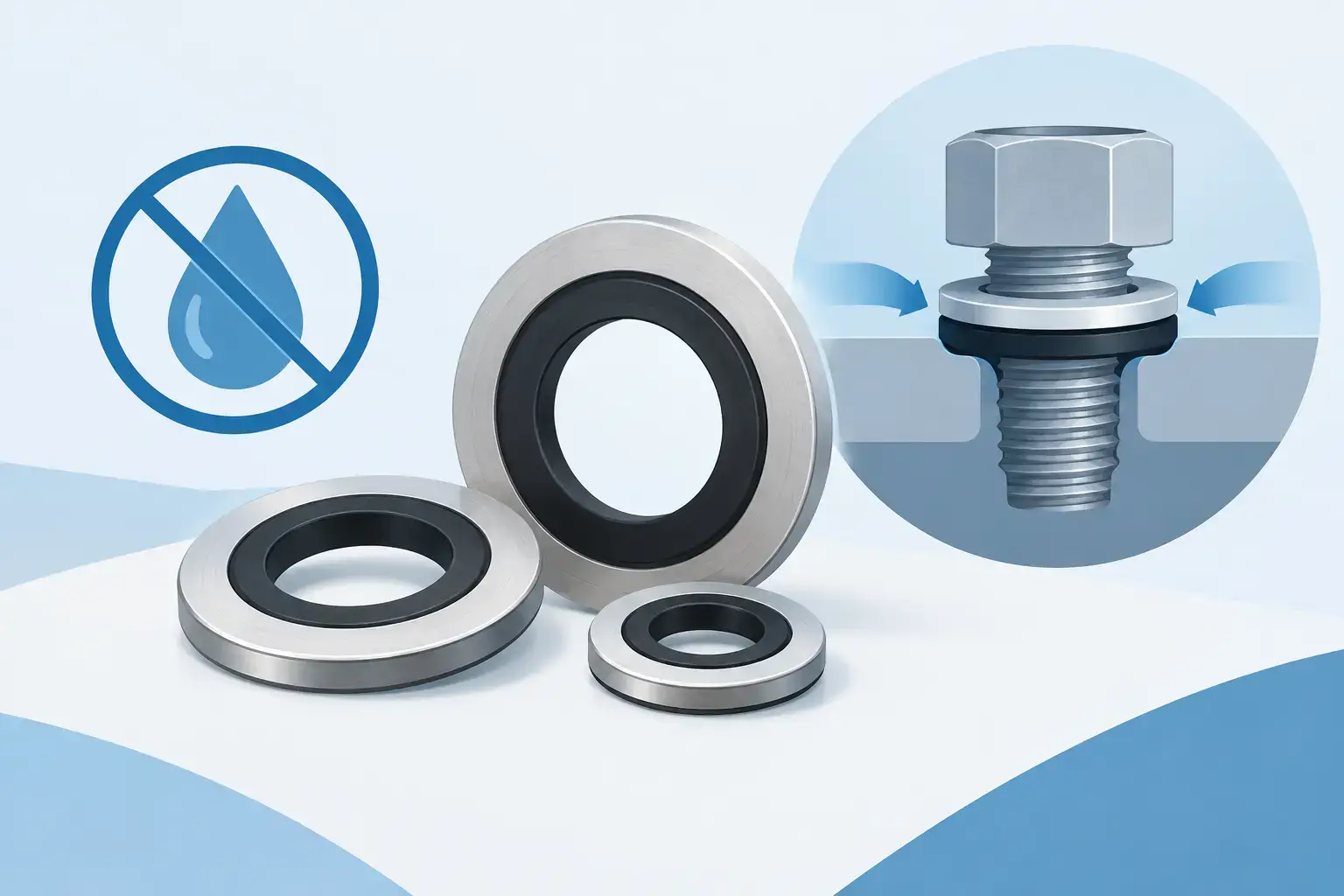
A bonded washer may be small, but its dimensions directly affect pressure retention, leak prevention, and equipment uptime. Correct bonded washer dimensions ensure the metal carrier fits the hardware while the elastomer sealing element compresses in the right location. A washer that is only slightly undersized, oversized, or incorrectly thick can create a leak path that leads to fluid loss, contamination, safety exposure, and unplanned maintenance.
For maintenance teams and purchasers, the objective is not simply to match a washer by appearance. The goal is to identify a sealing component that fits the thread, seating face, operating pressure, fluid, and installation arrangement with complete confidence.
The Three Bonded Washer Dimensions That Matter
A bonded washer combines a rigid metal ring with an elastomer seal bonded to its inside diameter. When a bolt, screw, plug, or fitting is tightened, the metal ring controls compression while the elastomer deforms to close gaps between the fastener and the mating surface.
Three measurements define most bonded washer sizes: inside diameter, outside diameter, and overall thickness. Each one has a separate job in creating a dependable seal.
| Dimension | What it controls | Why it matters | |—|—|—| | Inside diameter (ID) | Clearance around the bolt or fitting shank | Must fit the fastener without binding or leaving excessive unsupported clearance | | Outside diameter (OD) | Coverage of the sealing face | Must sit fully on a clean, flat seating surface and avoid overhanging an edge or recess | | Overall thickness | Compression range and installed stack height | Must allow the rubber element to compress without crushing, extruding, or preventing proper thread engagement |
The ID is often the first dimension buyers use to identify a bonded washer, such as a size intended for a 1/4-inch, 3/8-inch, M8, or M12 fastener. However, nominal bolt size alone is not a complete specification. Fastener threads, fitting standards, washer series, and seat geometry can vary. Always compare the actual washer ID and OD with the equipment drawing, sample part, or measured mating surfaces.
The OD deserves equal attention. It determines whether the washer provides enough bearing area for the elastomer to seal. If the OD is too small, the sealing lip may sit near a chamfer, counterbore, or uneven surface. If it is too large, it may interfere with adjacent components or bridge a recessed seating area. Either condition can compromise pressure containment.
How to Measure Bonded Washer Dimensions Correctly
Use calibrated calipers for ID, OD, and thickness measurements. A worn washer can be useful for identifying a general size, but it should not be the only source of information. Heat, chemical exposure, over-compression, and extrusion can change the elastomer profile, while corrosion can alter the metal ring.
Measure the inside diameter at several points if the washer is used or distorted. Record the metal ring diameter and, when possible, the opening created by the elastomer seal. On some designs, the rubber lip extends slightly inward of the metal carrier. This feature is intentional: it allows the elastomer to make contact with the bolt or fitting shank as the joint is tightened.
Measure the outside diameter across the metal carrier, not only across any displaced rubber. Then measure overall thickness on an uncompressed area of the washer. If the part has a visible sealing bead or a stepped profile, note that feature rather than assuming it is a standard flat washer.
For a replacement order, the most useful information includes the measured ID, OD, thickness, fastener or fitting thread, fluid being sealed, operating pressure, and any temperature or chemical exposure concerns. A clear photo of the washer beside a scale can also help confirm profile and construction when a part number is unavailable.
Nominal Sizes vs. Actual Measurements
Nominal size labels are convenient, but they do not replace dimensional verification. A washer identified as “M10” is generally intended for an M10 application, yet its actual ID is larger than 10 mm to provide installation clearance. Likewise, a bonded washer associated with a 1/2-inch fitting is not necessarily interchangeable with every 1/2-inch threaded component.
Thread standards matter. Metric, UNF, UNC, BSPP, BSPT, NPT, and hydraulic fitting systems can have different sealing arrangements even when the nominal diameter seems similar. Some joints seal on a flat face beneath a bolt head, while others rely on a shoulder, port face, or machined counterbore. The washer must match the sealing method, not just the thread callout.
Thickness and Compression: Where Many Sealing Problems Begin
Overall thickness is more than a catalog number. It influences how much the elastomer can compress before the metal carrier limits further movement. That controlled compression is one of the main advantages of a bonded washer over a standard flat washer with a separate O-ring.
Too little compression may leave channels for fluid to escape. Too much compression can damage the elastomer, force it into clearances, or flatten it to the point that it cannot maintain contact through thermal cycling and vibration. Excessive tightening can also deform the metal ring or damage the mating surface.
The correct installed condition depends on the hardware design and torque requirement. For that reason, bonded washers should be tightened to the equipment manufacturer’s specification whenever one is available. Increasing torque after a leak appears may seem practical, but it can turn a marginal seal into a failed one. Before retightening, inspect the seating surfaces, washer alignment, thread engagement, and condition of the elastomer.
Match Dimensions to the Sealing Surface
A properly sized bonded washer needs a suitable surface to seal against. The mating face should be clean, flat, and free of deep scratches, corrosion, paint buildup, burrs, or embedded debris. Even an accurately sized washer can leak if it is installed against damaged metal.
The seating face must also provide enough continuous contact area beyond the washer ID. A narrow flange, oversized chamfer, or recessed port can leave part of the elastomer unsupported. Under pressure, that unsupported material may extrude or fail to maintain uniform compression.
This is especially relevant in hydraulic systems, water-management equipment, irrigation assemblies, industrial pumps, and process equipment. In these applications, a recurring leak is not always a material problem. It may be a dimensional mismatch between the washer, fitting, and sealing face.
Material Selection Still Affects Dimensional Performance
Bonded washer dimensions establish physical fit, but elastomer selection determines how that fit performs in service. Nitrile is commonly selected for many petroleum-based oils and hydraulic fluids. EPDM is often used where water, steam, or certain glycol-based fluids are present. Fluorocarbon materials may be considered for elevated temperatures and more demanding chemical exposure.
The metal carrier also matters. Zinc-plated steel is common for general industrial service, while stainless steel may be preferred where corrosion resistance is critical. The right combination depends on the medium, temperature, pressure, environment, and required service life.
A washer with the right ID, OD, and thickness can still fail early if the rubber is incompatible with the fluid or the metal carrier is not suited to the environment. Conversely, premium material cannot compensate for an incorrect size. Reliable sealing requires both correct dimensions and compatible materials.
A Practical Specification for Purchasing and Maintenance
When the original part number is known, use it. When it is not, avoid ordering based only on a description such as “rubber washer for hydraulic fitting.” A usable specification should state the nominal application, actual ID, OD, overall thickness, metal type, elastomer type, and the fluid or service conditions.
For critical equipment, include the system pressure and whether the washer seals beneath a bolt head, nut, plug, banjo fitting, or threaded adapter. This context helps prevent a common error: selecting a washer that fits over the fastener but does not cover the actual sealing land.
International Seals can help maintenance teams translate sample dimensions and application details into a replacement bonded seal selection. Technical guidance is particularly valuable when equipment is older, documentation is incomplete, or a repeated leak suggests that the previous part was not correctly matched.
When a Standard Size Is Not Enough
Standard bonded washer dimensions cover many hydraulic and industrial applications, but custom or nonstandard requirements do occur. A special OD may be needed to cover a wider sealing face. A different thickness may be required to suit a recessed port. In other cases, the application may call for a specific elastomer profile, stainless carrier, or material compatible with aggressive process media.
Do not force a near-match into service simply because it is available. The short-term convenience can result in repeat maintenance, lost production, and greater risk to surrounding equipment. Confirm the interface before installation, especially when the joint operates under pressure or handles fluids that create contamination or safety concerns.
The right bonded washer is one that fits the joint as designed, compresses predictably, and continues protecting the system long after installation. Careful measurement at the start is one of the most practical ways to prevent a small sealing component from becoming a costly operational interruption.
Leave a Reply