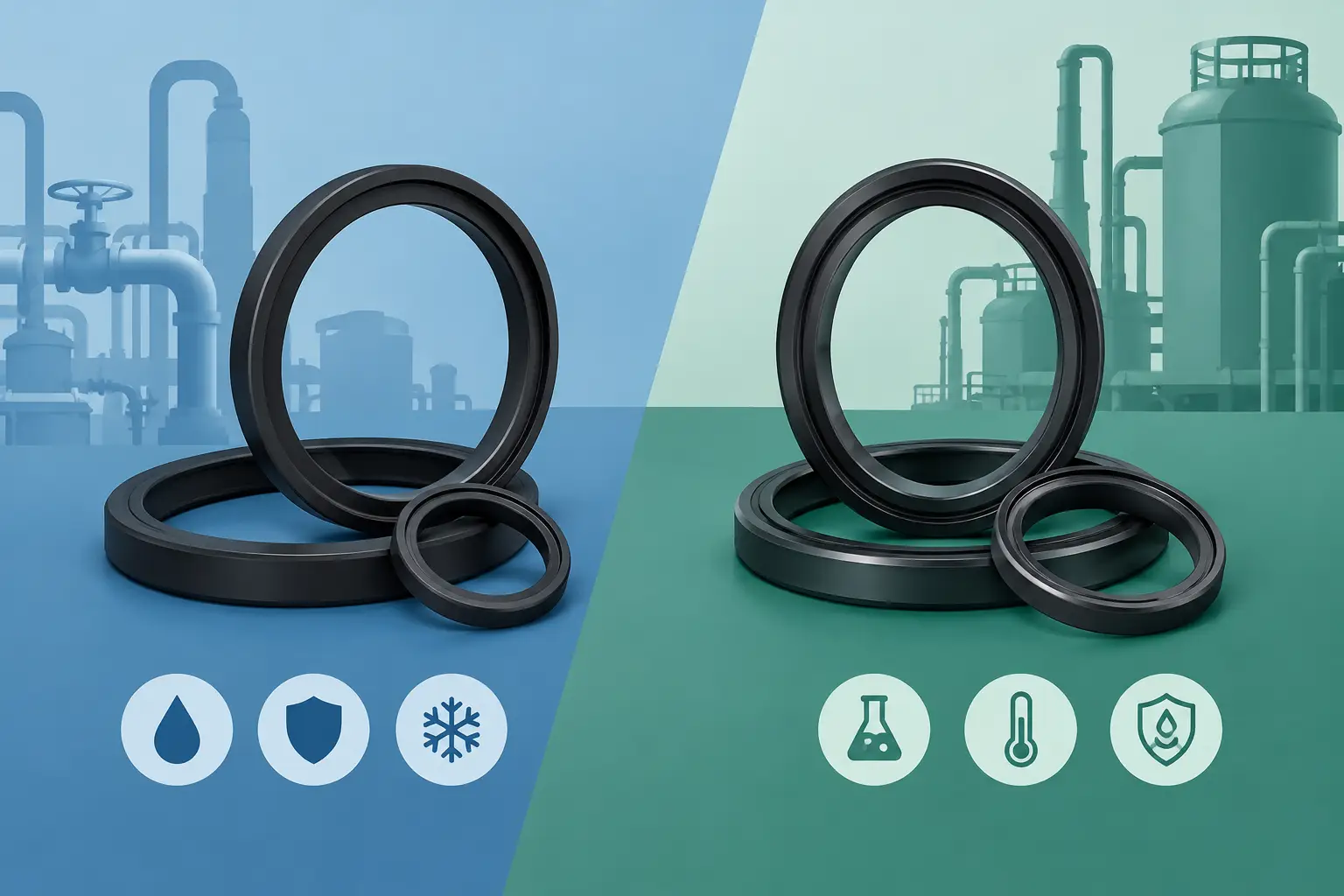
A seal that performs well in a water line can fail quickly after exposure to petroleum oil. The reverse is equally true. When maintenance teams compare EPDM vs Viton seals, the correct choice comes down to the actual media, operating temperature, pressure, and service conditions – not simply which material sounds more durable.
Both elastomers are proven options for O-rings, bonded seals, gaskets, and other industrial sealing components. Each can provide dependable leakage protection in the right application. The risk comes from treating them as interchangeable when their chemical resistance profiles are very different.
EPDM vs Viton Seals: The Core Difference
EPDM, or ethylene propylene diene monomer, is widely selected for water, steam, weather exposure, and many polar fluids. It is a practical material for municipal water systems, irrigation equipment, washdown service, brake-fluid applications, and certain process systems where heat and outdoor exposure are part of daily operation.
Viton is a widely used trade name often associated with FKM fluoroelastomer materials. It is generally chosen for high-temperature service involving petroleum-based oils, fuels, many solvents, and aggressive industrial chemicals. FKM seals are common in hydraulic equipment, engines, pumps, compressors, fuel systems, and chemical-processing operations.
The most decisive distinction is simple: EPDM handles water and steam exceptionally well but is usually a poor choice for petroleum oils and fuels. Viton performs strongly in oil and fuel environments but is generally not the preferred material for hot water or steam service.
Choosing the wrong material can lead to swelling, hardening, cracking, loss of elasticity, or extrusion. Any of these failures can compromise pressure retention, create fluid loss, and force unplanned maintenance.
Where EPDM Seals Perform Best
EPDM is valued for its resistance to water, hot water, steam, glycol-based fluids, many detergents, and outdoor aging. It also has excellent resistance to ozone, sunlight, and weathering. For assets that operate outside or encounter regular washdown cycles, those characteristics can support longer, more reliable service.
In water-management and irrigation applications, EPDM O-rings and gaskets are often a dependable choice for valves, couplings, pumps, and distribution equipment. The material can also serve food and beverage or pharmaceutical washdown systems when the specific compound meets the required regulatory and sanitation requirements.
EPDM typically remains flexible across a broad temperature range, often around -60°F to 300°F depending on the compound and application. That makes it useful in cold-weather water systems as well as elevated-temperature water service. However, temperature alone does not determine suitability. Pressure, cycling frequency, mating surfaces, and the presence of additives all affect seal life.
EPDM Limitations to Plan For
EPDM should not be the default choice where mineral oil, diesel, gasoline, lubricating oil, or petroleum-based hydraulic fluid is present. Exposure to these media can cause the material to swell and lose mechanical strength. Even a small amount of oil contamination can become a concern in an otherwise water-based system.
This is why application details matter. A cooling system may use water and glycol, which suits EPDM, but a nearby shaft or fitting may be exposed to oil mist. The seal material must match the fluid it will actually contact throughout its service life.
Where Viton Seals Perform Best
Viton seals are commonly selected when high temperatures and petroleum-based media occur together. They offer strong resistance to many oils, fuels, lubricants, hydrocarbons, and chemical-processing fluids. For industrial equipment operating near engines, gearboxes, hydraulic systems, or fuel-handling components, FKM can provide the protection needed to control leakage and sustain pressure.
Typical applications include rotary shaft seals, O-rings in hydraulic equipment, pump seals, compressor components, fuel-system seals, and gasket systems in chemical or oil-and-gas service. Viton is also known for good resistance to ozone, sunlight, and weathering, making it suitable for many outdoor applications involving compatible fluids.
Many FKM compounds are rated for continuous temperatures near 400°F, with some specialized formulations capable of handling higher intermittent temperatures. That heat resistance is a major advantage where standard elastomers may harden or take a compression set too quickly.
Viton Limitations to Plan For
Viton is not a universal chemical solution. It is generally not recommended for hot water or steam, and it may not be compatible with ketones, certain esters, amines, or some brake fluids. It also tends to have weaker low-temperature flexibility than EPDM. In cold environments, a standard FKM compound can become less elastic, increasing the risk of leakage during startup or pressure cycling.
Cost is another consideration. Viton often carries a higher initial price than EPDM. That premium may be justified when oil, fuel, chemical exposure, or elevated temperature would quickly damage a less suitable material. Paying more for the correct seal is often far less costly than a shutdown, cleanup, or damaged component.
Compare Operating Conditions Before Choosing
Material selection should begin with the service environment, not the existing part number. A seal may fit the same gland dimensions in either EPDM or Viton, but dimensional fit alone does not ensure equipment reliability.
Review the fluid being sealed, including additives, cleaners, contaminants, and possible process upsets. Confirm both normal and peak operating temperatures. Consider pressure level, pressure spikes, shaft speed where applicable, and whether the equipment cycles frequently. Storage conditions also matter, especially for spare parts exposed to heat, direct sun, or ozone-generating equipment.
For a water valve, hot-water circulation loop, glycol-based cooling system, or steam-related application, EPDM is often the stronger starting point. For petroleum hydraulic fluid, diesel, gasoline, lubricating oil, or many hydrocarbon chemicals, Viton is commonly the better candidate.
There are important exceptions. A particular compound may be modified for a specific compliance requirement, chemical, temperature range, or mechanical property. In addition, the seal design can change the answer. A static O-ring has different demands than a dynamic rotary shaft seal, and a high-pressure bonded seal may require specific hardness and extrusion resistance beyond base polymer selection.
Material Choice Is Only One Part of Seal Performance
Even the best elastomer will not compensate for an incorrect seal size, damaged groove, poor surface finish, excessive shaft runout, or improper installation. Seal failure investigations often reveal multiple contributing factors rather than a material issue alone.
For O-rings and bonded seals, verify the cross-section, inside diameter, groove dimensions, pressure direction, and hardware condition. For rotary shaft seals, review shaft finish, shaft hardness, lip design, spring configuration, rotational speed, and lubrication. For gasket systems, account for flange condition, bolt load, thermal expansion, and compression limits.
A practical selection process also considers availability and maintenance planning. Standardizing on one material can simplify inventory, but not if that decision forces a compromise across very different services. Keeping critical spare seals matched to their actual applications helps maintenance teams respond faster without introducing avoidable compatibility risks.
Questions That Prevent the Wrong Purchase
Before ordering EPDM or Viton seals, procurement and maintenance teams should be able to answer several basic questions: What fluid will contact the seal? What are the normal and maximum temperatures? Is the seal static, reciprocating, or rotary? What pressure and pressure spikes will it see? Are food-contact, potable-water, or chemical-compliance requirements involved?
If the answers are incomplete, provide as much equipment and operating information as possible. A seal specialist can help identify whether EPDM, FKM, nitrile, silicone, PTFE, or another material is a better fit for the job. This is especially valuable for replacement parts when the original material is unknown or the equipment has been moved into a different service environment.
International Seals supports industrial buyers with selection guidance for O-rings, bonded seals, rotary shaft seals, mechanical seals, and gasket systems. The goal is not simply to supply a part that fits. It is to help customers select a component that protects equipment, maintains pressure, and supports dependable operation.
When the media and temperature point in different directions, pause before making a material substitution. A short review of the application can prevent the leak, safety exposure, and downtime that follow a seal choice made on appearance alone.
Leave a Reply