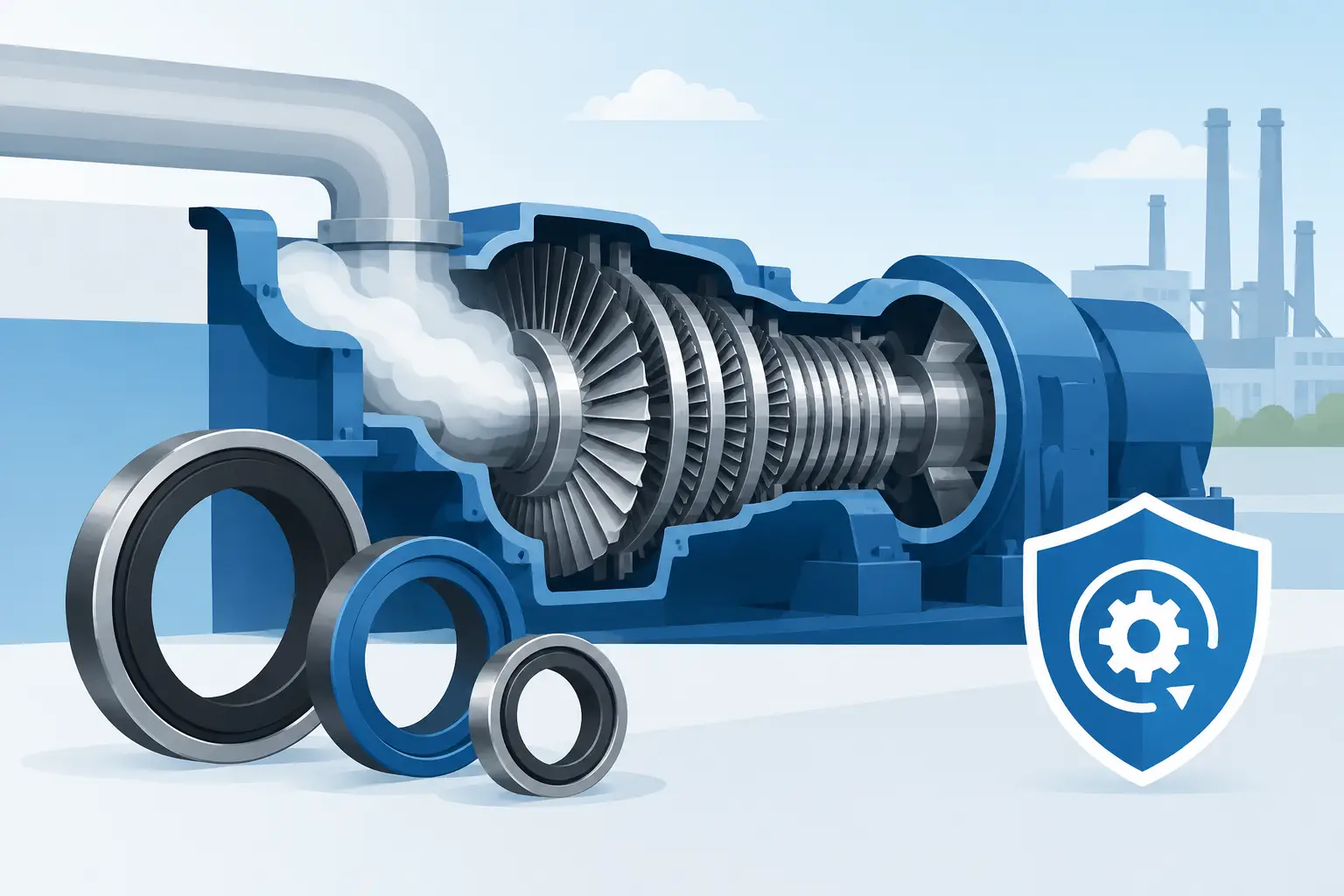
A turbine can appear mechanically sound while losing performance through a small but persistent leak path. Steam turbine sealing solutions address those losses at the shaft ends, casing joints, valve connections, and other critical interfaces where pressure containment and controlled clearances matter. For maintenance and operations teams, the objective is straightforward: retain steam where it belongs, prevent air intrusion where vacuum conditions exist, and protect equipment availability.
In power generation, a sealing issue rarely stays isolated. Escaping steam can create safety concerns, raise heat-rate losses, damage nearby components, and increase the burden on auxiliary systems. Air ingress on the low-pressure side can reduce condenser vacuum and compromise turbine output. The right sealing approach helps maintain pressure, preserve efficiency, and give teams greater confidence between planned outages.
Why Steam Turbine Sealing Performance Matters
Steam turbines operate across major pressure and temperature changes, often for extended periods between maintenance windows. Seals must perform through thermal cycling, vibration, shaft movement, startup conditions, and varying load demands. A part that fits dimensionally but does not suit the operating environment may fail early or create an avoidable leakage path.
The consequences are not limited to lost steam. External leakage can expose personnel to hot surfaces and pressurized vapor. Internal leakage can bypass stages that should be producing work, reducing turbine efficiency without producing an obvious alarm. At the turbine exhaust end, air leakage can upset vacuum conditions and increase oxygen-related corrosion risks in associated systems.
That is why seal selection should be treated as a reliability decision, not simply a replacement-parts purchase. Maintenance teams need to know what is leaking, why it is leaking, and whether the underlying cause is wear, misalignment, damaged hardware, incorrect clearance, pressure cycling, or a material limitation.
The Main Areas That Require Sealing Attention
A complete turbine sealing strategy considers both rotating and static interfaces. Each has a different job, and each presents different trade-offs during selection and maintenance.
Shaft-End Gland Seals
Shaft-end seals, often called gland seals, control leakage where the turbine shaft passes through the casing. Their role changes with turbine location and operating conditions. At high-pressure locations, the seal must limit steam loss. At low-pressure locations, it may also help prevent outside air from entering areas operating below atmospheric pressure.
Labyrinth designs are widely used because they operate without direct rubbing contact under normal conditions. Their close-clearance geometry restricts flow while avoiding the friction and wear associated with a full-contact seal. The trade-off is that performance depends heavily on maintaining correct clearances. Shaft movement, rubs, erosion, deposits, or casing distortion can increase leakage over time.
Brush seals can provide a tighter restriction in applications where lower leakage is needed, but they introduce a different maintenance consideration. Their bristles operate closer to the shaft and may be more sensitive to shaft surface condition, transient events, and installation accuracy. Carbon ring arrangements are another established option in certain turbine designs, particularly where controlled contact and effective leakage control are required. The best choice depends on the turbine configuration, operating history, and OEM requirements.
Casing, Steam Chest, and Joint Seals
Static joints require dependable containment just as much as shaft penetrations do. Turbine casings, steam chests, valve covers, flanges, and inspection openings can all rely on gasket systems or precision-machined sealing surfaces. These locations must hold pressure through thermal expansion and contraction without relaxing, cracking, or allowing a leak to develop at the joint line.
Gasket selection depends on the joint design, temperature, steam pressure, flange condition, bolt load, and surface finish. A gasket material that is appropriate for a lower-temperature auxiliary steam line may not provide the same performance in a high-energy steam service. Equally, overtightening fasteners can damage a gasket or distort mating surfaces, while insufficient load can leave a path for leakage.
When a casing joint leaks after reassembly, the answer is not always a thicker gasket or higher bolt torque. Teams should inspect flange flatness, surface damage, fastener condition, alignment, and the installed gasket’s dimensions. Correcting the joint condition protects the new seal and reduces the chance of repeating the repair during the next outage.
Auxiliary Equipment and Support Systems
The turbine system includes more than the main casing. Control valves, gland steam systems, condensate-related equipment, pumps, gearboxes, and other support equipment may use O-rings, bonded seals, mechanical seals, rotary shaft seals, and gaskets. A minor seal failure in an auxiliary component can create a larger operational problem if it affects lubrication, cooling, condensate handling, or gland steam control.
For these components, the service media and motion type matter. A static O-ring may be appropriate for a properly designed stationary connection, while a rotary shaft seal or mechanical seal is intended for equipment with rotating shafts. Substituting one style for another without considering pressure, speed, temperature, and shaft condition can shorten service life and increase downtime.
How to Select a Seal for the Actual Operating Condition
The most reliable replacement begins with accurate application information. Part numbers are useful, but they do not always tell the full story, especially on older equipment that has been modified or rebuilt. A supplier or maintenance planner should confirm the equipment model, seal location, dimensions, service temperature, pressure conditions, media, and whether the seal works against a rotating or stationary surface.
Operating history is equally valuable. If the same seal has failed repeatedly, ask what changed before the failure. Was there a recent overspeed event, trip, bearing repair, shaft repair, alignment correction, or process upset? Did leakage begin after a shutdown and restart, or did it develop gradually? These details can distinguish normal wear from an installation or equipment-condition problem.
Material selection should be practical rather than generic. Steam, condensate, lubricating oil, cleaning chemicals, and ambient contaminants can all affect seal behavior. Temperature range, compression set resistance, chemical compatibility, and the ability to maintain dimensions through cycling should be matched to the application. In critical equipment, selecting the lowest-cost part without confirming suitability can cost far more in lost production and emergency labor.
Installation Practices That Protect Seal Life
Even a correctly specified seal can underperform if installation is rushed. Before assembly, surfaces should be cleaned and inspected for nicks, corrosion, burrs, scoring, and deposits. Mating components must be positioned correctly, and damaged hardware should be addressed rather than covered up with sealant or excessive tightening.
For static joints, use the specified tightening pattern and load requirements. Uneven compression can create a leak path at one section of the gasket while overstressing another. For shaft-related seals, confirm shaft surface condition, runout, alignment, and clearance requirements. A worn shaft sleeve or misaligned component can quickly defeat a new seal.
It also helps to document the repair. Record the removed component condition, installed seal identification, measured dimensions, and any observed equipment damage. This creates a useful baseline for future outage planning and helps identify recurring failure patterns before they become an unplanned event.
Planning Inventory Without Overbuying
Critical spares reduce outage risk, but stock should be based on equipment importance and lead-time exposure, not guesswork. Fast-moving O-rings, bonded seals, gaskets, and common auxiliary-equipment seals may justify on-site inventory. Application-specific turbine components may require planned sourcing, verified dimensions, and clear receiving inspection before an outage begins.
The strongest approach is to identify seals associated with high-consequence failure points, standardize specifications where possible, and maintain traceable records. Procurement teams also benefit from a supplier that can help confirm selections, provide transparent pricing, and give delivery visibility when a repair becomes urgent.
International Seals supports industrial buyers with practical selection guidance across gasket systems, O-rings, bonded seals, mechanical seals, and rotary shaft seals used in demanding equipment environments. The goal is not simply to supply a component, but to help maintenance teams receive a seal that fits the application and supports reliable operation.
When a turbine seal is due for replacement, treat the work as an opportunity to verify the condition of the entire sealing interface. The right component, installed on sound hardware with the correct clearances and loading, can prevent a small leak from becoming the next costly interruption.
Leave a Reply