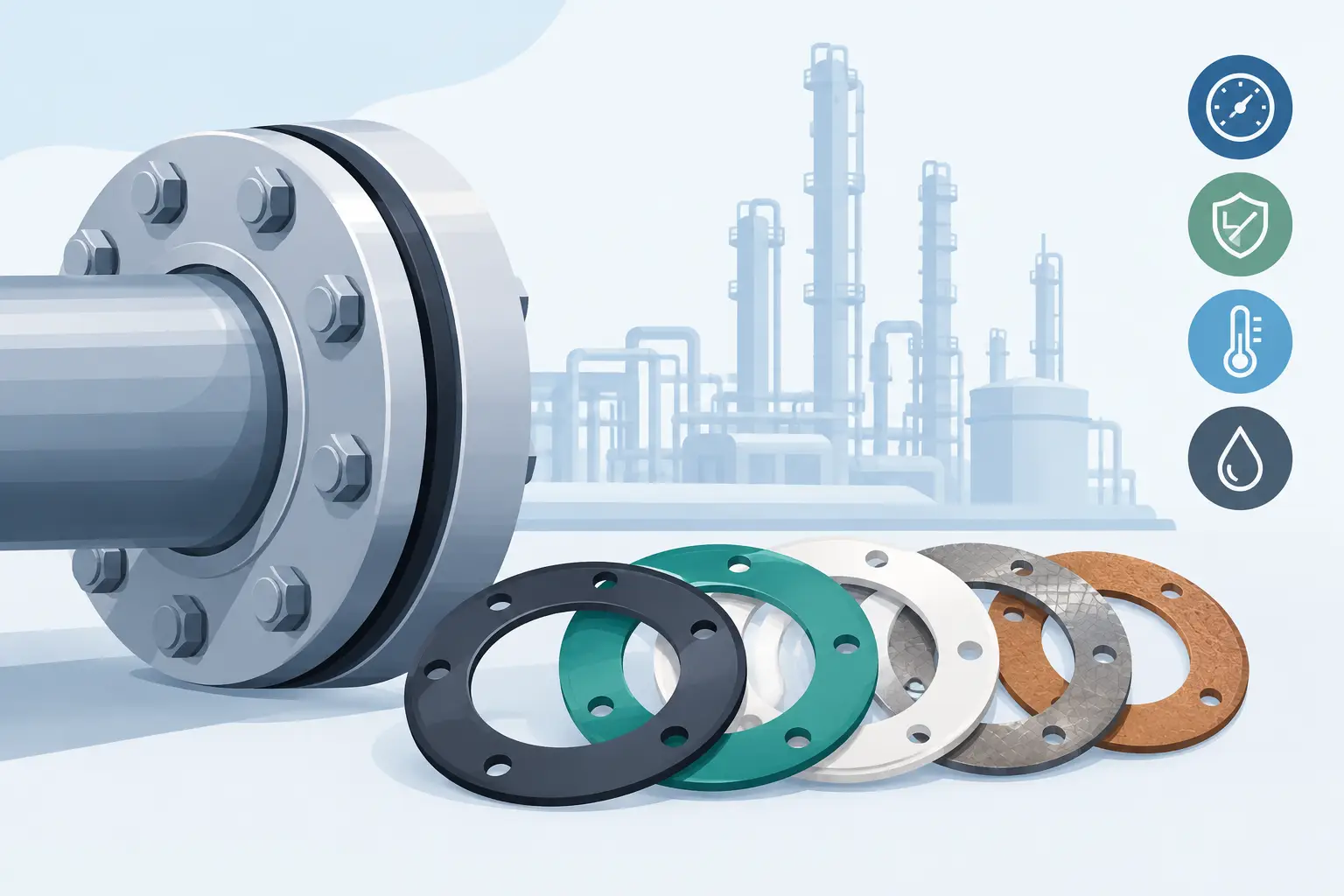
A high pressure flange gasket is often a small component in a large process system, but its failure can stop production, release hazardous media, damage equipment, and create an urgent maintenance event. Selecting one by flange size alone is not enough. The gasket must maintain a reliable seal under the actual combination of internal pressure, temperature, fluid, bolt load, flange condition, and operating cycle.
For maintenance teams, engineers, and procurement professionals, the goal is straightforward: specify a gasket system that holds pressure consistently, protects the equipment, and supports planned maintenance instead of unplanned shutdowns. That requires looking beyond a catalog description and understanding what the application demands from the joint.
What Makes a High Pressure Flange Gasket Different?
High-pressure service places greater force on every part of a bolted flange joint. As internal pressure rises, it acts against the gasket and attempts to separate the flanges. The gasket needs enough compressive load to fill minor surface irregularities and establish a seal, while the bolts and flange must retain that load throughout operation.
A gasket used in this environment must resist extrusion, blowout, crushing, chemical attack, and changes caused by heat or pressure cycling. A material that performs well on a low-pressure water line may not be suitable for a steam system, a hydrocarbon process, or a pressurized chemical application.
The practical issue is not simply whether a gasket can tolerate a stated pressure rating. Performance depends on the complete joint. A correctly selected gasket can still leak if the flange faces are damaged, bolts are unevenly tightened, or the available bolt load cannot achieve proper compression.
Start With the Real Operating Conditions
The best gasket selection begins with the conditions at the flange, not the nominal service description. Obtain the normal operating pressure and temperature, but also ask about startup, shutdown, pressure surges, steam-out cycles, and upset conditions. These events may be more demanding than normal operation.
The process media matters just as much. Water, air, lubricating oil, fuel, steam, acids, solvents, slurry, and compressed gases all affect gasket materials differently. Chemical compatibility helps prevent softening, swelling, embrittlement, or loss of sealing force over time. For regulated food, pharmaceutical, or potable-water systems, material suitability and contamination control may also guide the selection.
It is also necessary to confirm whether the service is static or subject to vibration, thermal movement, or repeated cycling. Equipment that runs steadily at one temperature can often use a different solution than equipment that repeatedly heats, cools, starts, and stops. Cycling increases the chance that bolt load will relax or the gasket will lose recovery, allowing a leak path to develop.
Match the Gasket Type to the Flange Joint
Flange design determines how the gasket is located and loaded. Raised-face, flat-face, ring-type joint, tongue-and-groove, and other flange configurations do not use the same gasket geometry or sealing approach. A gasket must match the flange facing, nominal pipe size, pressure class, and applicable dimensional standard.
Sheet and Compressed Fiber Gaskets
Compressed fiber and other sheet gasket materials are commonly used across industrial utility and process applications. They can provide dependable performance when the media, temperature, pressure, and flange finish are within their intended range. They are also practical for many maintenance situations because they are widely available in standard sizes and can be supplied for nonstandard equipment needs.
Their limitation is that high-pressure or high-temperature conditions may demand more controlled loading and greater resistance to creep than a general-purpose sheet material can provide. A thicker gasket is not automatically a better gasket. Excess thickness can require more compression, increase relaxation, and make it harder to maintain a stable seal under cycling.
Spiral Wound Gaskets
Spiral wound designs are a frequent choice for demanding refinery, power generation, chemical processing, and high-temperature piping service. Their metal winding and filler construction can accommodate thermal cycling while providing strong sealing performance when installed with the correct flange configuration and bolt load.
These gaskets are not a universal answer. They require proper alignment, compatible flange faces, and controlled tightening. Damage during handling or installation can compromise the seal before the system is pressurized. In critical service, confirm the winding material and filler are suitable for the media and temperature rather than selecting based on size alone.
Ring-Type Joint Gaskets
For severe high-pressure applications, ring-type joint gaskets provide a metal-to-metal sealing method designed for specific grooved flange faces. They are commonly used where pressures, temperatures, and service conditions exceed the range of conventional soft gaskets.
This approach depends heavily on precise mating surfaces and correct ring selection. Reusing a ring gasket or installing it in a damaged groove can introduce unnecessary risk. When a joint is opened, inspect the flange groove and sealing surfaces carefully before selecting a replacement.
Metal and Jacketed Gasket Options
Metal, corrugated metal, and jacketed gasket configurations may be appropriate where process conditions require higher mechanical strength or a specific sealing profile. Their suitability depends on flange finish, available bolt stress, thermal movement, and media compatibility. The right choice is application-specific, which is why equipment details are more useful than a simple request for a “high-pressure gasket.”
Bolt Load Is Part of the Seal
A gasket does not seal on its own. It seals because the bolted joint applies and maintains enough compressive force across the gasket surface. Too little load can leave gaps around the flange. Too much load can crush the gasket, damage the facing, distort the flange, or reduce long-term recovery.
Use a controlled tightening process that follows the equipment manufacturer’s requirements and applicable site procedures. Bolts should be tightened in a cross-pattern sequence and brought to load progressively, not pulled down one side at a time. Lubrication, bolt condition, washer use, and tool calibration all affect the actual clamp load achieved.
Retorquing is not always appropriate, particularly after a system has been placed in service or exposed to temperature. Follow the gasket manufacturer’s guidance and plant safety procedures. The key is consistency: a properly selected gasket needs uniform compression around the entire joint.
Inspect the Flange Before Replacing the Gasket
A new gasket cannot compensate for a flange that is warped, deeply scratched, corroded, or improperly aligned. Before installation, clean the contact surfaces and inspect for pitting, radial scoring, weld spatter, embedded old gasket material, and damage at the raised face or groove.
Check flange parallelism and bolt-hole alignment. Forcing misaligned piping into position with bolts can impose stress on the joint and lead to leakage later. If a flange has leaked repeatedly, treating every event as a gasket issue can waste time and inventory. The underlying cause may be inadequate bolt load, poor pipe support, thermal expansion, vibration, or an unsuitable flange surface finish.
Avoid the Most Common Selection Errors
Many flange leaks trace back to a few preventable mistakes. Ordering by outside diameter without confirming the flange standard can result in an incorrect seating area. Choosing the lowest-cost material without reviewing chemical and thermal exposure can shorten service life. Reusing gaskets, installing them dry when the approved procedure requires a specific treatment, or applying an unapproved sealant can also create avoidable failures.
Another common error is assuming a higher pressure class eliminates the need for application review. Pressure class, flange material, temperature, bolts, and gasket construction work together. A high-rated component in one part of the joint does not correct a weak point elsewhere.
When information is incomplete, record the flange type, line size, pressure class, media, temperature range, bolt details, current gasket style, and reason for replacement. Those details allow a sealing specialist to narrow the options quickly and reduce the chance of receiving a part that fits physically but performs poorly in service.
Build Reliability Into Your Gasket Supply Plan
For critical systems, gasket selection should be paired with a practical inventory plan. Standardize proven gasket types where possible, but do not force every service into one material. Keep traceable replacement stock for high-consequence joints and establish clear identification so maintenance personnel can distinguish similar-looking gaskets.
International Seals supports industrial buyers with application-focused gasket guidance and a broad sealing portfolio for demanding equipment. Direct access to knowledgeable specialists can be especially valuable when a process change, recurring leak, or obsolete component makes standard ordering uncertain.
A dependable flange seal is created before the bolts are tightened: with accurate operating data, a compatible gasket design, sound flange surfaces, and an installation process that delivers even load. Give the joint that level of attention, and it can maintain pressure, protect people and equipment, and keep your operation on schedule.
Leave a Reply