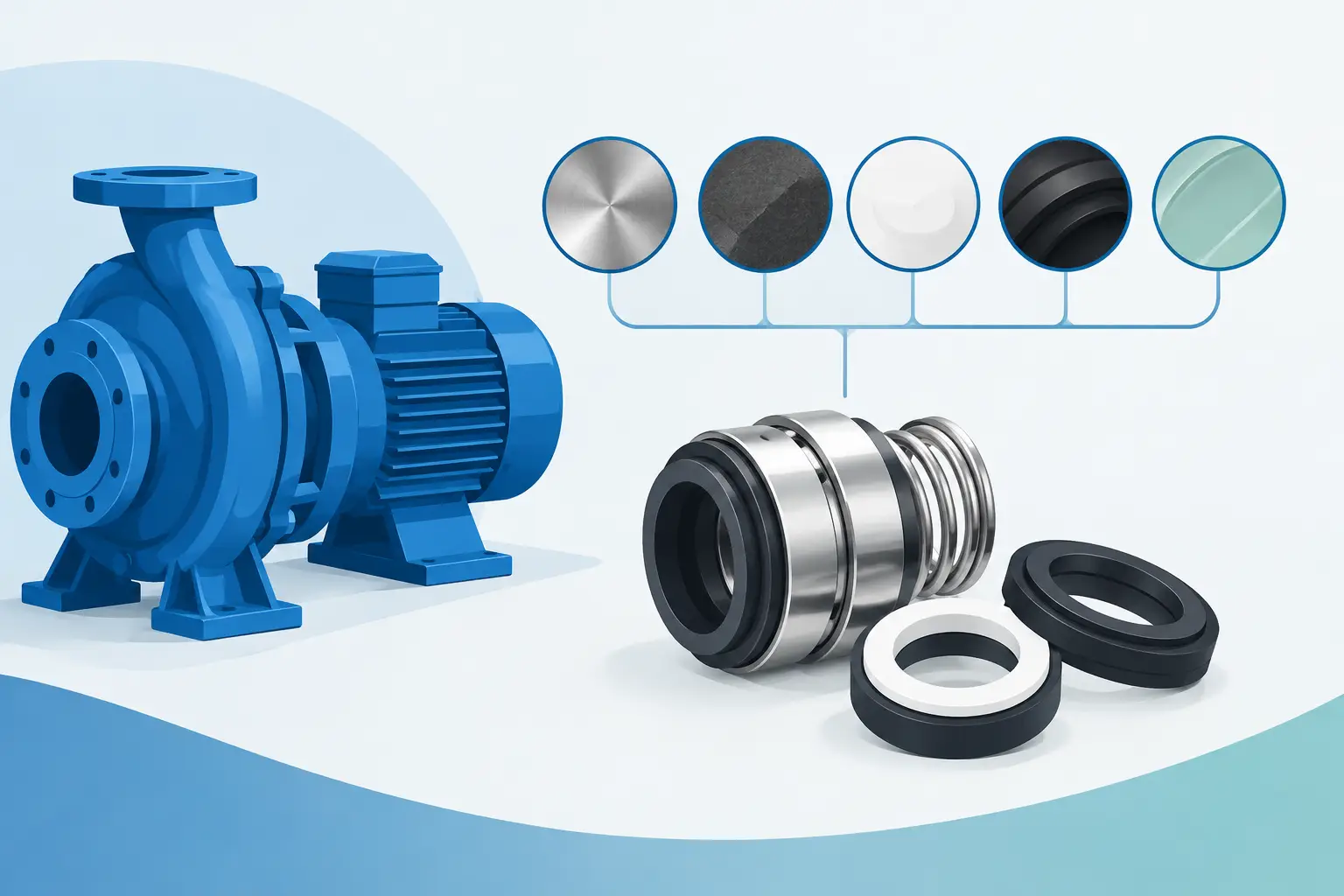
A mechanical seal can look like a small replacement part until the wrong face or elastomer puts a critical pump out of service. Knowing how to choose mechanical seal material means looking beyond shaft size and seal dimensions. The fluid, operating temperature, pressure, solids, duty cycle, and equipment condition all affect whether a seal maintains containment or becomes the source of a costly leak.
For maintenance teams and purchasing professionals, the goal is not simply to find a material that works at startup. It is to specify a seal combination that protects equipment, maintains pressure, supports safe operation, and delivers dependable service between planned maintenance intervals.
Start with the Fluid Being Sealed
The process fluid is usually the first and most decisive factor in mechanical seal material selection. A material that performs well in clean water may fail quickly in hydrocarbons, caustics, acids, solvents, slurries, or food-processing liquids. Chemical attack can swell secondary seals, weaken bonding, corrode metal components, or damage the seal faces themselves.
Begin by identifying the exact fluid, not just its general category. For example, a water-based solution may contain chlorides, cleaning chemicals, suspended solids, or additives that change the sealing requirement. In chemical processing, concentration matters as much as the chemical name. A diluted acid and a concentrated acid can require very different material combinations.
Also consider what enters the pump during cleaning, flushing, shutdown, or upset conditions. A seal designed only around normal process fluid may be exposed to hot washdown water, steam, CIP chemicals, or a temporary solvent. The correct selection must account for the full operating environment.
Match Face Materials to Wear, Heat, and Lubrication
Mechanical seal faces are the primary sealing surfaces. They operate in close contact with a thin fluid film between them, so their material pairing directly affects friction, heat generation, wear, and leakage control.
Carbon is widely used as one seal face because it offers good lubricity and performs well across many general industrial pumping applications. It is often paired with a harder mating face. However, carbon is not a universal answer. Certain aggressive chemicals, high temperatures, dry-running events, or abrasive services may call for a different arrangement.
Silicon carbide is a common choice for demanding applications because it provides excellent wear resistance and handles abrasive fluids well. It is often selected for wastewater, slurry service, oil and gas applications, and fluids containing solids. Its high thermal conductivity can also help manage heat at the seal interface. The trade-off is that silicon carbide is harder and more brittle than some alternatives, so proper installation and operating conditions remain essential.
Tungsten carbide is another hard face material used where strength and resistance to shock or abrasion are needed. It can be a strong option for certain slurry, oil, and industrial process duties. Material grades vary, and chemical compatibility must still be checked before selection.
Ceramic faces can provide reliable performance in clean, moderate-duty services, particularly in water applications. They are cost-effective but can be less suitable for heavy solids, thermal shock, or severe mechanical stress. A ceramic face may be the right choice for a clean-water pump, while a silicon carbide pairing may provide greater protection in abrasive wastewater service.
The best face combination depends on the application. Clean lubricating fluid, poor-lubricity fluid, intermittent dry running, abrasive particles, and high shaft speed create different demands. Choosing the hardest available face is not automatically the best decision. The materials must work together under actual operating conditions.
Choose Secondary Seals for Chemical Compatibility
Secondary seals, including O-rings, wedges, and gaskets within the mechanical seal assembly, prevent leakage around components that do not rotate against one another. Their material selection is just as important as face selection because an incompatible elastomer can swell, harden, crack, or lose elasticity.
Nitrile, commonly called Buna-N, is frequently used in petroleum-based oils, water, and many general industrial applications. It is a practical material for suitable services, but it is not the preferred choice for strong acids, many solvents, or high-temperature applications.
FKM materials are often selected for higher temperatures, fuels, oils, and many chemical services. They offer broad resistance, but they are not compatible with every chemical and may not be the right fit for hot water, steam, certain amines, or strongly alkaline fluids.
EPDM performs well in hot water, steam, glycol-based fluids, and many cleaning solutions. It is commonly used in water-management, food-production, and washdown applications. However, EPDM is generally not suitable for petroleum oils and hydrocarbon fuels.
PTFE is valued for wide chemical resistance and is often used where elastomers cannot tolerate the process fluid. It can be an effective choice for aggressive chemicals, but its lower elasticity changes the seal design and installation requirements. It is not a direct substitute for every elastomeric O-ring.
When reviewing an application, specify the exact elastomer or polymer rather than accepting a general description such as “chemical resistant.” Material compatibility should be confirmed against the fluid, temperature, and concentration the seal will experience.
Account for Temperature and Pressure Together
Temperature and pressure are closely connected in seal performance. Higher temperatures can reduce elastomer life, alter fluid viscosity, increase vapor pressure, and place greater stress on seal faces. Higher pressure can increase closing force at the faces and affect extrusion resistance in secondary seals.
A seal material that handles a given fluid at room temperature may not provide the same protection at elevated process temperatures. Likewise, a material rated for a certain pressure in clean, lubricating service may have a shorter service life when the fluid runs hot or contains solids.
Consider normal operating conditions as well as startup, shutdown, and upset conditions. Pumps may see temperature spikes after loss of cooling, pressure surges during valve changes, or dry-running risk during low-tank conditions. These events often determine whether a seal lasts for years or fails early.
For critical systems, it is useful to document the full operating range: minimum and maximum temperature, normal and maximum pressure, shaft speed, fluid properties, and expected transient conditions. This gives a seal specialist the information needed to recommend a material combination with an appropriate operating margin.
Evaluate Solids, Abrasion, and Dry-Running Risk
Abrasive solids can rapidly wear seal faces and damage springs, hardware, and secondary seals. Sand, mineral scale, catalyst fines, fibers, product crystals, and wastewater grit each create different risks. If solids are present, consider their size, concentration, hardness, and whether they settle when the pump stops.
Hard face materials such as silicon carbide or tungsten carbide are often preferred in abrasive service, but the seal design also matters. A suitable flush plan, barrier fluid, cyclone separator, or equipment modification may be needed to keep solids away from the sealing interface. Material selection alone cannot overcome a poor operating environment.
Dry running requires equally careful attention. Without adequate lubrication, seal faces can overheat in seconds. Carbon-based face combinations may tolerate brief upset conditions better in some applications, while hard-face pairs may be more vulnerable to thermal damage if the process fluid disappears. If intermittent dry running is likely, identify the cause and consider both material selection and operational safeguards.
Do Not Overlook Metal Parts and Hardware
Mechanical seal springs, glands, retainers, and other metal components also need to withstand the service environment. Stainless steel may be appropriate for many duties, but chloride-containing fluids, acids, seawater, or corrosive process chemicals may require a higher-alloy construction.
Corrosion of springs or metal hardware can cause loss of closing force, sticking components, and unexpected leakage even when the faces and O-rings appear correct. The material review should cover the complete seal assembly, not only the primary sealing faces.
How to Choose Mechanical Seal Material for the Actual Pump
Material selection should always be tied to the pump and system, not treated as an isolated purchasing decision. Verify the pump model, shaft size, seal chamber dimensions, operating speed, pressure, temperature, and fluid details. If the failed seal is available, inspect it for clues such as cracked faces, worn tracks, swollen O-rings, corrosion, or deposits. Those signs often reveal whether the original issue was material incompatibility, heat, vibration, misalignment, cavitation, or solids contamination.
It also helps to distinguish between a direct replacement and an application upgrade. Matching the original seal may be appropriate when it achieved acceptable service life. If failures are recurring, the correct path may be a different face pairing, upgraded elastomer, alternate metal hardware, or a change to the system supporting the seal.
International Seals can help maintenance and procurement teams translate these operating details into a suitable mechanical seal configuration. Clear application information supports faster, more accurate selection and greater confidence that the replacement will protect the pump when it returns to service.
Before ordering, provide the fluid name and concentration, temperature range, pressure, pump model, shaft size, speed, presence of solids, and any known failure history. That level of detail turns a replacement request into a selection decision built around equipment reliability. The right seal material is the one that fits the real service conditions and gives your operation the protection it needs between maintenance windows.
Leave a Reply